Mobaderoon
Building a Values-Based Active Citizenship Network in Syria
Executive Summary
Since its establishment in 2010, Mobaderoon has evolved from a small volunteer initiative into one of Syria’s most extensive active citizenship networks. Throughout fifteen years of social transformation, conflict, displacement, recovery, and societal change, Mobaderoon has remained focused on a central question:
How can citizens become active contributors to shaping their communities and the future of their country?
The answer gradually evolved into what is now referred to as the Active Citizenship Methodology: a long-term approach that combines values-based engagement, learning, community action, leadership development, institutional strengthening, and network building.
Unlike traditional development models that begin with organizations and projects, the Mobaderoon experience began with people. A network of citizens emerged first. The organization developed later as a supporting structure designed to serve the network, mobilize resources, ensure sustainability, and connect local efforts to national and international opportunities.
Today, the Mobaderoon ecosystem consists of thousands of members, facilitators, community leaders, local initiatives, thematic networks, partner organizations, and community institutions working together to strengthen social cohesion, peacebuilding, active citizenship, and community resilience across Syria.
Origins: A Network Before an Organization
Mobaderoon was founded in 2010 as a community-driven movement of volunteers and social activists committed to strengthening civic engagement and social responsibility in Syria.
From the outset, Mobaderoon focused on bringing people together around shared values rather than shared identities. Participants came from different religious, ethnic, social, political, and geographic backgrounds but shared a belief that sustainable change requires citizen participation and collective action.
As the network expanded, members began creating local initiatives, organizing community activities, facilitating dialogues, and responding to local needs.
The growth of these activities created the need for a formal institutional structure capable of supporting and sustaining the network. Consequently, Mobaderoon evolved into an organization designed to serve the network and not the other way around.
The organization emerged to provide:
- Legal registration and compliance with governmental regulations.
- Financial and administrative systems.
- Grant management and donor compliance.
- Resource mobilization.
- Capacity development.
- Technical support.
- Partnership management.
- Monitoring, evaluation, and learning systems.
- National and international networking opportunities.
This dual structure became one of the defining characteristics of the Mobaderoon model.
The Network First, The Organization Second
A key principle of the Mobaderoon experience is that the network came before the organization.
The starting point was not an institution seeking participants. Rather, it was a growing community of citizens seeking opportunities to learn, connect, collaborate, and contribute to their communities.
As the network expanded, the organization evolved as an enabling platform that could respond to the requirements of governments, donors, and partners while protecting the spirit of community ownership.
The Active Citizenship Network became the source of ideas, leadership, innovation, and community action.
The organization became the platform responsible for:
- Governance and accountability.
- Financial and administrative management.
- Human resource systems.
- Resource mobilization.
- Grant management.
- Partnership development.
- Government relations.
- Capacity development.
- Technical support.
- Monitoring, evaluation, and learning.
- National and international networking.
- Development of joint programs and strategic initiatives.
This balance allowed Mobaderoon to combine the flexibility and ownership of a community network with the institutional capacity required to engage governments, donors, and international partners.
A Values-Based Active Citizenship Network
At its core, Mobaderoon is a values-based network.
The network is not defined by political affiliation, ethnicity, religion, geography, or profession. Instead, it is united by a shared commitment to values that guide both relationships and action.
These values include:
- Respect for diversity.
- Dialogue.
- Participation.
- Nonviolence.
- Transparency.
- Inclusion.
- Social responsibility.
- Shared ownership.
- Mutual respect.
- Social justice.
- Active citizenship.
Research conducted among members consistently demonstrated that these values were among the primary reasons individuals joined, remained engaged, and continued contributing to the network over many years. Members repeatedly described Citizenship Spaces as safe environments where they could express opinions, engage with diversity, and contribute to their communities.
The values-based nature of the network enabled individuals who might otherwise never meet to build trust, cooperate, and work collectively despite the divisions created by conflict and displacement.
The Active Citizenship Methodology
Over time, Mobaderoon developed a structured pathway through which citizens could evolve from participants into leaders, facilitators, institution builders, and contributors to broader social change.
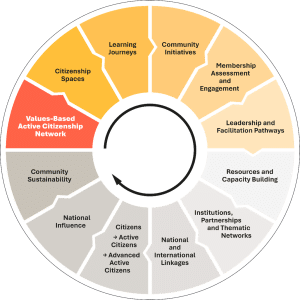
The methodology can be summarized as follows:
Throughout all stages, the Mobaderoon organization acts as the institutional platform that provides systems, governance, resources, partnerships, and technical support.
Citizenship Spaces
Citizenship Spaces are the foundation of the methodology.
They are safe, inclusive, and participatory environments where citizens can meet, exchange experiences, challenge assumptions, explore identity and belonging, discuss community issues, and collectively develop solutions.
Research findings demonstrated that members considered these spaces places where citizenship is practiced rather than simply discussed. Participants consistently highlighted safety, dialogue, diversity, learning, and participation as defining characteristics of the spaces.
These spaces became particularly important during the Syrian conflict, when opportunities for constructive dialogue and trust-building became increasingly limited.
Learning Journeys
Members entering Citizenship Spaces engage in long-term learning journeys designed to support both personal and social transformation.
Learning themes include:
- Active Citizenship.
- Identity and belonging.
- Dialogue and Communication.
- Nonviolence.
- Conflict Transformation.
- Peacebuilding.
- Community Leadership.
- Facilitation.
- Community Planning.
- Social Responsibility.
- Mediation and Negotiation.
The objective is not simply to transfer knowledge but to develop the skills, attitudes, values, and confidence required for active civic engagement.
Community Initiatives
Learning is intentionally connected to action.
Members are encouraged to identify challenges within their communities and design practical responses through initiatives, campaigns, volunteer actions, dialogue processes, and community projects.
These interventions have addressed a wide range of issues including:
- Social cohesion.
- Youth engagement.
- Women’s participation.
- Education.
- Environmental awareness.
- Community resilience.
- Peacebuilding.
- Local development.
Research participants consistently identified community initiatives as one of the most important factors sustaining their engagement, as they enabled members to witness tangible change resulting from their efforts.
Membership Assessment and Engagement
Membership within the network is not defined by attendance.
Rather, members are assessed based on:
- Commitment to shared values.
- Community engagement.
- Initiative leadership.
- Collaboration.
- Learning and development.
- Contribution to others.
- Long-term commitment to social change.
This approach transforms participants from recipients of services into active contributors and co-owners of the network.
Leadership and Facilitation Pathways
Members demonstrating commitment and leadership potential are supported through additional development opportunities.
These pathways include:
- Facilitation training.
- Leadership development.
- Mentorship.
- Community organizing.
- Mediation and dialogue facilitation.
- Program design.
- Team management.
- Representation at national and international levels.
Facilitation became one of the most distinctive elements of the methodology, enabling members to build trust, manage diversity, and transform conflict into constructive engagement.
Resources and Capacity Building
Mobaderoon recognizes that motivation alone cannot sustain civic engagement.
For this reason, the organization developed mechanisms to provide members and community groups with access to:
- Technical support.
- Advanced training.
- Mentoring and coaching.
- Small grants.
- Organizational development.
- Governance systems.
- Strategic planning support.
- Resource mobilization skills.
Research findings indicate that access to resources and institutional support significantly increased members’ ability to sustain community action and expand their impact.
Thematic Networks
As the network expanded, members increasingly organized themselves around common interests and areas of expertise.
Alongside geographic Citizenship Spaces, thematic networks emerged around issues such as:
- Peace Architect network: Dialogue and Conflict Transformation.
- Women’s Leadership women lead organizations network.
- PSS experts’ network.
- Facilitators network.
These thematic networks enabled deeper learning, peer support, collaboration, knowledge exchange, and the development of communities of practice that connected members across Syria.
Institutions and Partnerships
Over time, many initiatives evolved into formal organizations and community institutions.
Mobaderoon supported this process through:
- Governance development.
- Human resource systems.
- Financial management systems.
- Strategic planning.
- Monitoring and evaluation.
- Partnership development.
- Organizational capacity building.
This process created an expanding ecosystem of local organizations connected through shared values and collaborative action.
National and International Linkages
One of the strengths of the model is its ability to connect local actors to wider opportunities.
Members and organizations have been linked to:
- National networks.
- Regional learning platforms.
- International peacebuilding communities.
- Academic institutions.
- Donor agencies.
- Development organizations.
- Global communities of practice.
These linkages create a two-way flow of knowledge, allowing local experiences to inform broader discussions while bringing global expertise and opportunities back to communities.
Impact: From Citizens to Active Citizens to Advanced Active Citizens
The most significant contribution of the Active Citizenship Methodology has been its ability to transform how individuals perceive themselves and their role in society.
Citizens
Individuals enter the network as citizens seeking opportunities to learn, connect, and contribute.
Active Citizens
Through learning journeys, community initiatives, and engagement in Citizenship Spaces, participants become active citizens who take responsibility for addressing challenges in their communities and contribute to positive social change.
Advanced Active Citizens
As members gain experience and trust, many evolve into Advanced Active Citizens.
These individuals become facilitators, mentors, institution builders, peacebuilders, network leaders, and connectors between communities. They mobilize resources, create opportunities for others, support local governance processes, facilitate dialogue, and contribute to national conversations.
Many have gone on to establish organizations, lead thematic networks, support peacebuilding efforts, and strengthen community resilience mechanisms.
The ultimate impact of the methodology is therefore not simply the creation of projects or organizations, but the emergence of generations of Advanced Active Citizens capable of continuously contributing to the future of Syria.
National Influence
The ultimate objective of the Active Citizenship Methodology is not project implementation.
It is to contribute to a culture of active citizenship capable of influencing society at multiple levels.
Through thousands of citizens, hundreds of initiatives, dozens of organizations, and extensive partnerships, the network contributes to:
- Social cohesion.
- Peacebuilding.
- Civic participation.
- Community resilience.
- Inclusive governance.
- Youth leadership.
- Women’s participation.
- National dialogue processes.
- Community-driven development.
Local experiences generated through the network increasingly contribute to national conversations about Syria’s future.
Sustainability: The Spirit of Mobaderoon
The sustainability of Mobaderoon lies in its ability to create ownership rather than dependency.
Participants become members.
Members become facilitators.
Facilitators become leaders.
Leaders launch initiatives.
Initiatives evolve into organizations.
Organizations establish new Citizenship Spaces.
New Citizenship Spaces nurture new generations of active citizens.
This cycle continuously regenerates itself.
The greatest achievement of Mobaderoon is therefore not the number of projects implemented or grants managed. It is the creation of a living ecosystem of active citizens who continue to learn, act, lead, collaborate, and contribute to their communities long after individual projects have ended.
Mobaderoon is not simply an organisation.
It is a values-based active citizenship movement that has spent more than fifteen years investing in people, relationships, leadership, and community ownership as the foundation for a peaceful, resilient, and inclusive Syria.