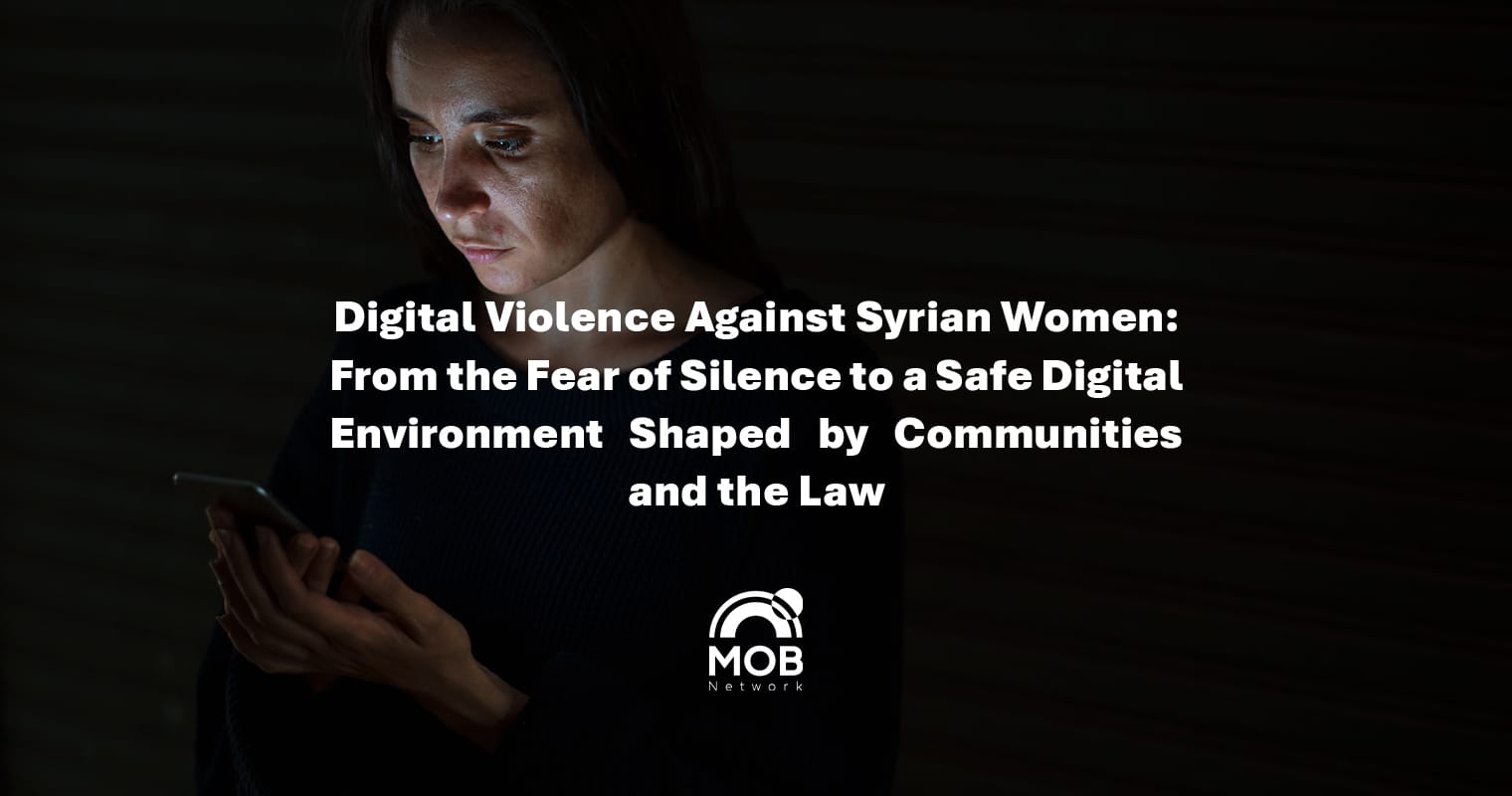

One cold night, Reem sat in front of her phone trying to finish her work duties after a long day.
The room was quiet, the sounds of intermittent electricity were familiar, and everything seemed normal… until a message arrived!
Her personal photo, taken two years ago on a trip with her friends, appeared before her, edited and distorted in a humiliating way, along with a direct threat:
“Pay up… I’ll publish it.”
The threat was nothing but an invisible slap, capable of changing her entire life.
The threat was nothing but an invisible slap, capable of changing her entire life.
At that moment, she didn’t think about the law or the police.
She thought about “the people”:
How will they see it?
How will they judge it?
Will they believe it?
Will they see the truth? Or will “the assumption” become a new reality that surrounds them?
As her hands trembled, she realized that the fear she felt was not from the image, but of a society that might point the finger at the victim, not the perpetrator.
and from a digital space that easily transforms into an arena for silent violence that leaves not bruises, but long, unseen scars.
Reem’s story is not an exception; it is a mirror to the hundreds of stories that Syrian women live through daily in a space that is supposed to be “virtual,” but which leaves a real impact on life, reputation, and psyche.
Here, the question becomes larger than a single incident:
What is digital violence? And why is it becoming increasingly dangerous in the Syrian context?
How can society and the law transform this space into a safe haven, rather than a tool for blackmail and silencing?
This is what we will discuss further in this article: this concept, its roots, forms, and effect
Digital violence: real violence, even if it is “virtual”
Within the framework of the 16 Days of Activism against Gender-Based Violence, digital violence stands out as one of the most dangerous forms of contemporary violence against women, especially in the Syrian context.
According to the definition of the United Nations agencies, digital violence or technology-facilitated gender-based violence is defined as: “Any act of violence that is committed, facilitated, or aggravated by the use of digital media (phone, internet, social media platforms…) and results in psychological, social, or economic harm, or restricts women’s freedom and right to public participation.”
Although digital violence leaves no physical bruises, its impact on the psyche and daily life is profound.
In Syria, where the effects of war, displacement, and poverty intersect with the fragility of legal and social structures, digital violence becomes an extension of gender-based violence in homes, streets, and workplaces, but this time behind a small screen overlooking an entire life.
Recent research reports concentrating on our region show that women in conflict zones in the Middle East are systematically threatened through digital space with the aim of silencing and excluding them from the public sphere.
One of the survivors summed up the experience with a hurtful statement: “The words on the screen were like stones being thrown at me relentlessly, but I couldn’t see them.”
One of the survivors Tweet
This simple sentence reminds us that digital violence is no less harmful than physical violence, and may even be a gateway to it, or a cause of long-term social isolation.
Features of digital violence in the Syrian reality: Stories from the “virtual street”
In a press report from northwest Syria, a young woman living in one of the camps stated that she was forced to sell her gold jewelry and hand over all her savings to a person who blackmailed her by posting personal photos and videos on social media, exploiting her economic vulnerability and her fear of societal stigma.
In a survey linked to the same report, 53% of the participants reported that they had been subjected to some form of digital violence, and 78% of them had considered suicide at some point as a result of this violence and blackmail.
Another story involves a university student from a large Syrian city whose Facebook account was hacked by someone claiming to be a family friend. He stole her private photos and then began threatening to publish them if she didn’t agree to meet him alone.
Her fear wasn’t from the “law” as it was the gossip of the neighbors, the looks of the family, her reputation at the university.
Here, digital violence is no longer just a threat on the network, but transforms into a complete social trap, where the victim is held accountable instead of the perpetrator.
A field study conducted by the “Salamtech” team in 2023 shows that out of every ten Syrian women who participated in the survey, six women were exposed to some form of digital violence, and that 64% of them reported that digital attacks affected their personal lives, and 23% thought of harming themselves as a result of despairing of the lack of real support.
This reality makes the digital space, in the eyes of many Syrian women, resemble a “narrow street in a conservative neighborhood”: whoever walks in it feels that all eyes are watching him, and any wrong step could turn into a collective scandal.
The psychological and social impact of digital violence: unseen wounds
Digital violence is not limited to momentary harm, but extends to deep psychological and social effects.
Reports on the digital safety of Syrian women indicate that most survivors suffer from symptoms of depression, anxiety, social isolation, loss of self-confidence, and a constant feeling of threat even after the blackmail or defamation incident has ended.
On a daily basis, a woman may be forced to leave her job because a colleague leaked private photos of her in the work group, another may be prevented from completing her studies after a fabricated digital rumor spreads about a “relationship” with someone, and a third may be forced to change her place of residence for fear that her whole life will turn into a “courtroom” where everyone judges her based on stolen or fabricated digital content.
One study shows that digital violence and its link to mental health indicate a clear relationship between exposure to this type of violence and higher rates of suicidal thoughts, identity disorders, and feelings of guilt among victims, especially in the absence of legal and social support.
In the Syrian environment, where the concepts of “reputation,” “honor,” and “shame” are still strongly presented, digital violence is used as a kind of “symbolic weapon” that always puts women on the defensive, even if they have not done anything wrong.
Here, a single image, or a single message, becomes enough to threaten an entire future.
Between law and society: Who faces digital violence?
Despite the existence of cybercrime laws in various parts of Syria, human rights studies and reports indicate a significant gap between the legal text and the actual reality. Penalties are often lenient, litigation procedures are complicated, and most importantly, the victim may be condemned socially or even legally simply for admitting to having photos or private relationships that were exploited by the perpetrator.
A woman who filed a lawsuit against someone who digitally blackmailed her told a lawyer that she felt more like she was in the dock during the investigation than like the perpetrator was the accused.
Here, digital violence becomes a vicious cycle: the woman is afraid to resort to the judiciary and chooses silence, and the abuser exploits her fear and increases his blackmail.
In contrast, important initiatives from civil society have emerged, such as digital security programs, confidential helplines for women who are subjected to digital violence, and training on protecting accounts and dealing with cyber extortion, such as the study and programs launched by “Salamtech” and other Syrian organizations that focus on women’s digital safety.
What we aspire to is to focus on developing programs to detect digital violence against women, analyzing forms of electronic violence directed at women through social media sites, and proposing more effective legal and educational responses, but these efforts, despite their importance, are still scattered.
The role of society in creating a safe digital environment for Syrian women
A safe digital environment is built not only with laws, but also with a new community culture.
Digital violence thrives on three main incubators: silence, justification, and blame directed at the victim.
When we hear about a girl who has been subjected to online blackmail and we say, “If she hadn’t sent the pictures, this wouldn’t have happened,” we are practically giving the perpetrator a social license to continue.
Despite all its complexities, Syrian society can play an important role in confronting digital violence through practical steps, including:
Changing the narrative within the family: Parents should know that their daughter who comes to them crying because of a digital threat needs containment, not punishment, and families should realize that their daughter is the victim and not an “accomplice to the crime.”
The role of friends and colleagues: to be a “first line of defense” and not a “source of leaks” that turns the story into material for bullying and curiosity.
The role of schools and universities: to integrate the topic of digital violence and digital safety into awareness activities, as part of education on citizenship and human rights.
The role of the media and digital platforms: to stop presenting blackmail stories as “scandals,” and to focus on the structure of the violence itself, and on the responsibility of the perpetrator, not the victim.
The role of the judiciary and police: to recognize the sensitivity and privacy of digital violence cases, and for the legal system to be stricter with perpetrators and more compassionate and trusting towards survivors.
International reports on technology-facilitated gender-based violence also clearly indicate that an effective response requires integrated action: legislation, safe reporting platforms, psychological and legal support, and media campaigns that change the stereotypical image of women in the digital space.
A female activist at a workshop on digital security said:
“The first step to protecting women from digital violence is to stop asking: Why did you trust him? And start asking: Why did he betray and exploit your trust?”
From “fear of scandal” to “the right to a safe space”
Today, with the 16 Days campaign focused on making technology a force for equality, not a tool for harm, talking about digital violence in the Syrian context becomes a moral and humanitarian necessity, not a human rights luxury.
The digital space is like a vast Syrian city: it has dark alleys where blackmailers and bullies operate, and it also has bright squares built by associations, initiatives, and women’s and youth groups.
The question is not: Should we prevent women from entering this city to protect them? Rather: How do we illuminate its streets, protect those who walk in it, and hold accountable those who turn it into a dangerous place?
The future of a safe digital environment for Syrian women begins with transforming individual stories into collective awareness:
We should see in every survivor of digital violence a witness to a flaw in the system, not an “individual mistake.”
Let’s redefine “scandal”: Scandal is not a stolen image, but a society that blames the victim and remains silent about the perpetrator.
We must move from the logic of “we kept silent so that the crisis would pass” to the logic of “we spoke out so that it would not happen again.”
“The internet is not a blind fate; either we make it a space for a more just life, or we let it turn into a new arena for the same old violence.”
At last, building a safe digital environment for Syrian women is not the responsibility of one party: it is a new social contract between families, schools, the media, organizations, and legislators.
During the 16 Days campaign, we can start raising our voices, but the most important thing is to continue after the campaign ends; because digital violence does not stop after December 10, just as women’s struggle for a safe space in which they can live and express themselves without fear does not stop.