
In a world still plagued by gender-based violence, the voices of women survivors often remain muted or oppressed.
The 16 Days of Activism against Gender-Based Violence campaign forms a global framework for raising awareness, highlighting and empowering women’s voices, and promoting strategies to counter violence.
Narrative storytelling refers to the way people use stories to understand their lives, experiences, and identity. It helps organize and interpret events, understand feelings and thoughts, and form an image of themselves and the world around them. It can also be used therapeutically to help individuals reframe their stories in a healthier and more optimistic way.
Its method of use usually involves several steps, such as identifying the experience or event to be understood, telling the story as the person sees it now, analyzing the story to look for patterns, beliefs and emotions associated with it, reframing the story in a way that gives a deeper or more positive meaning, and integrating the new narrative into daily life to affect behavior and feelings in a healthy way.
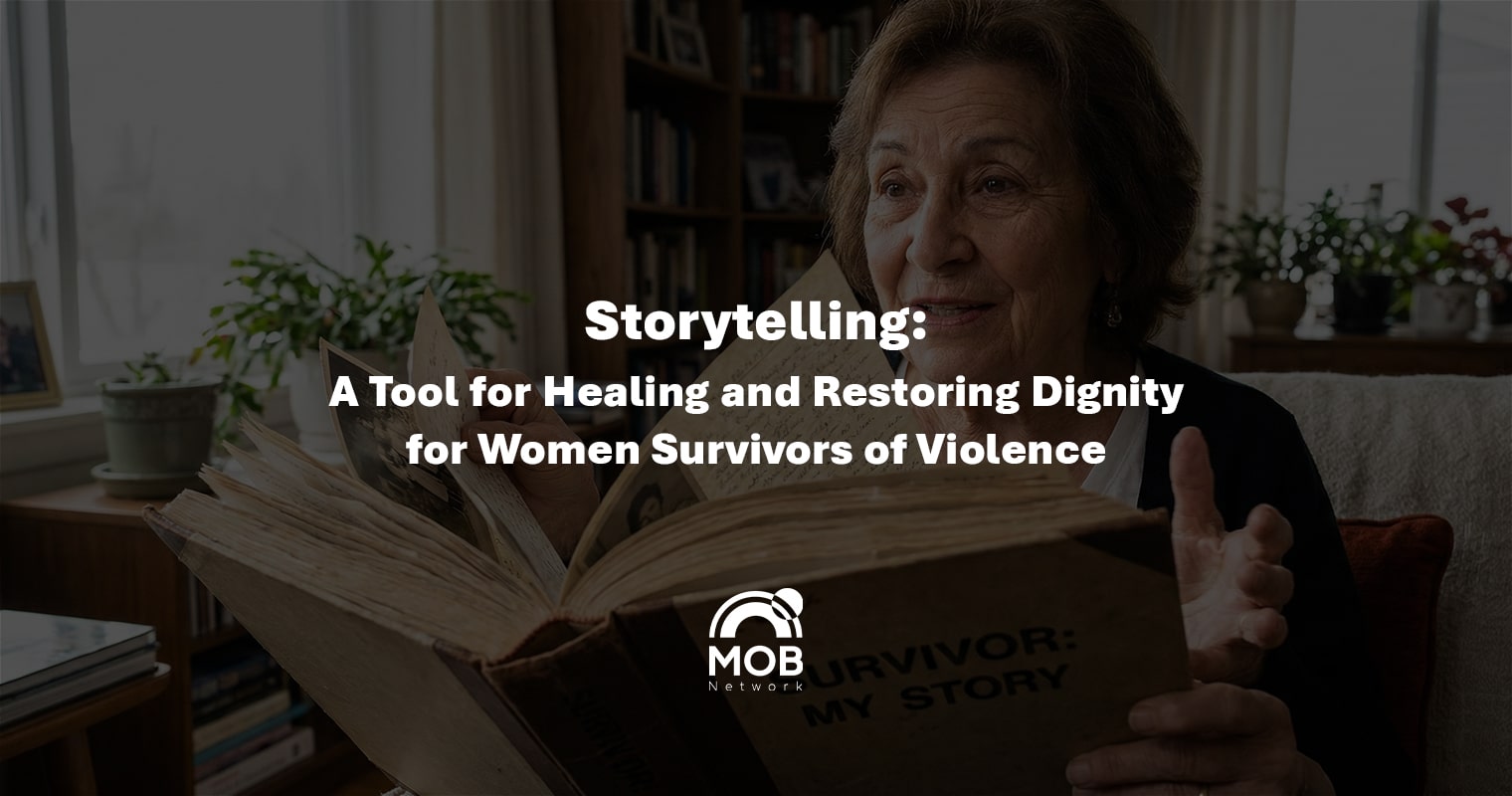
Narrative storytelling is an effective means of understanding and organizing human experiences, especially for women survivors of gender-based violence.
This concept has evolved across the fields of psychology, anthropology, and social sciences to become a therapeutic and research tool that helps individuals rebuild their identity and understand their lives more deeply.
Storytelling has also become a central tool for restoring self-esteem and community.
Understanding the role of stories in healing and restoring strength and dignity helps to transform pain into a tool for empowerment and rebuilding the social fabric.
Through storytelling, a woman can transform from a silent victim into a social actor, restoring her sense of power and dignity.
In this context, storytelling is considered a central means of expressing pain, processing trauma, and regaining control.
In supportive social contexts, personal stories can be an effective way to support activism against violence.
Personal stories can provide opportunities for individuals to shape broader narratives about violence against women and women’s right to share their stories.
Also, telling a personal story about violence can support women’s ability to make decisions and contribute more to the collective struggle against violence directed against women.
“I feel like I’ve found myself again. I’m no longer living in fear… Everything has changed in my outlook on life.”
This is how a woman described her experience after therapy through storytelling.
The origins of storytelling in psychotherapy
In the late twentieth century, Michael White and David Epston (1990) founded what is known as Narrative Therapy, which focuses on the ability of individuals to rewrite their life stories and make sense of their experiences, including trauma and suffering.
Later, Catherine Reissman (2008) developed systematic approaches to studying personal narrative, explaining how stories reveal identity and human experience.
David Denborough (2014) also highlighted the importance of narrative for women survivors and marginalized groups to regain control of their lives.
Storytelling according to the World Health Organization
The World Health Organization defines storytelling in health communication as:
“An art and a science combined, connecting people, shaping their world, and changing their lives.”
The organization asserts that storytelling makes information more understandable and impactful, humanizes suffering, and inspires the public through success stories.
Digital storytelling as a therapeutic tool
A research paper entitled “Digital Storytelling as a Therapeutic Intervention for Trauma Narratives in Women Survivors of Intimate Partner Violence” aimed to explore the effectiveness of digital storytelling as a therapeutic tool for women survivors of intimate partner violence who have suffered from post-traumatic stress disorder (PTSD).
This study explored digital storytelling that blends text, sound, images, and music to help survivors rebuild a coherent personal narrative that supports recovery and the restoration of a sense of self.
The combination of image, text and sound creates a multi-sensory expression process that facilitates the processing of the painful experience and gives it new meaning.
In this paper, researcher Kim Anderson explains that survivors often suffer from fragmented and incoherent memories of the experience, difficulty verbally expressing the trauma, and a sense of loss of identity, desire, and control.
Therefore, the therapy sessions included writing the story text, choosing images, recording audio, and combining them together to produce a digital narrative piece that expresses their experience with violence and healing.
The paper’s results showed a 26-point decrease after intervention through digital narrative, such as alleviating avoidance, emotional numbness, nightmares, and hypervigilance.
Digital storytelling can be an effective means of psychological and social healing, helping to build a coherent narrative of traumatic experiences.
“By writing my story and sharing my photos and voice, I felt like I was reclaiming my life. I was no longer just a victim, but someone who could express herself and move forward with confidence.”
Narrative Exposure Therapy (NET)
Narrative Exposure Therapy is a specialized form of narrative therapy, developed by Thomas Elbert and his team in the 1990s in Germany to help survivors of multiple traumas such as war, torture, and domestic violence.
Therapy focuses on retelling traumatic events and organizing traumatic memories into a chronological order or sequential story, as well as linking traumas to positive life experiences.
This has proven effective in alleviating depression and anxiety and restoring a sense of control.
In addition, research conducted in women’s shelters in Afghanistan and Turkey has shown that women sharing their experiences while in supportive environments helps build psychological resilience and create a collective support network that reduces the sense of social shame resulting from stigma or abuse.
Storytelling as a tool of resistance and empowerment for women against violence and social stigma through psychological resilience
These stories empower women to challenge the social stigma associated with physical appearance or negative beliefs about women with mental health disorders, experiences of motherhood and infertility, divorce and widowhood, because these prevent women from seeking help or treatment due to fear of societal judgment.
When women share their stories, pain becomes a tool for advocacy. Silence in the face of stigma weakens psychological resilience and may lead to intense emotional distress that loses positivity, while narrating and reinterpreting the experience enhances resilience.
Rebuilding the protective personal traits that act as protective resources for women against stressful events to restore their ability to use their capabilities and potential to perceive events in a logical and undistorted way.
By sharing stories, whether through platforms or support and empowerment groups, the act transforms from a personal experience into a collective action that promotes dignity, demonstrating that storytelling is not merely words but a transformative force in society. It is not simply an individual therapy tool but a social act.
Thus, the narrative transcends the boundaries of individual healing to become a tool of social and political resistance that allows for a change in societal discourse about violence and enables women to participate in decision-making in their community.
Practical Recommendations
- Creating storytelling workshops in shelters and support centers with female trainers, advocates, and mentors.
- Developing secure digital platforms for producing digital stories that combine audio, text, and images.
- Using narrative in media advocacy and awareness campaigns.
- Training staff in narrative therapy techniques
- Ensuring the safety and confidentiality of survivors and giving them the freedom to choose to participate.
In Conclusion
Digital or therapeutic storytelling (NET) stands out as a powerful tool for women survivors of gender-based violence, enabling them to rebuild their identities and lives, address trauma holistically, create human connections that help restore dignity and the ability to express themselves, improve their self-perception and worldview—especially after experiencing social stigma—and ultimately enhance their social integration and support for social change.
It is not just a story, but a healing and transformative force that enables women to reclaim their lives after experiencing violence.